Right, before you spend a penny on this stuff, let’s get the confusion sorted. PT-141 gets talked about online like there’s one product with different price tags. There isn’t. There are two completely different aisles here, running on two completely different rulebooks, and most of the arguments you’ll read are just people in aisle one shouting past people in aisle two.
Aisle one: a clinician looks at your history, decides whether this drug is right for you, and a licensed pharmacy compounds and ships it under your name. Aisle two: you find a website, tick a box that says “for laboratory research only,” and a bag of powder turns up with nobody having asked you a single question about your health.
This is the plain-English map of both aisles. Where it’s safe, where it isn’t, and a five-question checklist you can run on any seller to work out which aisle you’ve actually wandered into. Every claim below is tied to a primary source you can open and check for yourself.
The one line that should decide this for you
Here’s the fact that does most of the work in this whole decision: PT-141 raises your blood pressure. Every single dose. That’s not me being cautious, it’s printed on the FDA-approved label for the brand version, Vyleesi. The label states that bremelanotide (PT-141’s proper name) transiently raises blood pressure and drops heart rate after each dose, usually settling back down within about 12 hours [P3]. On the back of that, the same label rules the drug out entirely for anyone with uncontrolled hypertension or known cardiovascular disease [P3].
Think about what that means for where you buy it. If a drug carries a written warning about your heart, then the single most useful job a seller can do is check whether your heart can take it. That’s the whole test. One aisle does that check. The other one legally cannot, because it isn’t selling you a drug in the first place.
So as you read the rest of this, keep asking one question: does this route put a person between me and a drug that lifts my blood pressure, or does it just stick a bottle in a jiffy bag?
What you’re actually buying
PT-141 is bremelanotide, a lab-made peptide that acts on melanocortin receptors in the brain. The NIH LiverTox monograph describes it as hitting several of these receptors, mainly MC1R and MC4R, with the MC4R activity being the part linked to sexual desire [P4]. That’s a different mechanism to the blood-flow drugs most people think of in this category. It’s working on the nervous system, not the plumbing.
Here’s the twist that makes PT-141 different from the usual research-peptide fare, and the bit sellers lean on hard. It actually has a real FDA approval attached. The FDA approved bremelanotide in 2019 under the brand name Vyleesi [P1] [P2]. So technically, a seller isn’t lying when they say “PT-141 is FDA-approved.” What they’re leaving out is how narrow that approval is: one brand product, a 1.75 mg autoinjector, for one specific group, premenopausal women with acquired, generalized hypoactive sexual desire disorder. The label is explicit that it isn’t for men, isn’t for postmenopausal women, and isn’t a performance product [P3].
Which means most of what actually gets bought, and pretty much all use in men, is off-label or compounded, not the approved branded product. Both facts are true at once. The brand is approved, in its lane. What’s in most people’s carts isn’t that brand. A straight seller keeps those two facts sitting next to each other. A seller chasing a quick sale lets the word “approved” do work it hasn’t earned.
Aisle one: the trade counter
This is the route that treats PT-141 like the prescription drug it actually is. You go through a licensed telehealth provider, a clinician reviews your history (including the heart and blood-pressure questions the label cares about), a prescription gets written when it’s appropriate, and a licensed pharmacy compounds and dispenses it. Somebody’s name is on the paperwork, and somebody has actually checked the risk that matters.
FormBlends is where I’d send a mate first. It’s built around the screening step rather than skipping past it. It’s a licensed telehealth provider, not a chemical warehouse. PT-141 comes to you via a clinician who can weigh up the cardiovascular contraindication, a prescription when it’s warranted, and a licensed pharmacy that does the actual compounding. Supervised pricing runs roughly $90 to $250 a month depending on the protocol, for the same molecule the grey market will post you with zero questions asked. An independent 2026 roundup comparing where to buy peptides landed on the same conclusion, ranking FormBlends its top pick and pointing to the physician-supervised model and pharmacy sourcing [S1].
I’ll be straight about the trade-off, because there is one. Going through a clinician means an intake, which means it’s slower than dumping a vial in a basket and checking out. You’ll wait a bit. But on a drug with a written cardiovascular warning, that wait isn’t a hassle to route around, it’s the safety feature doing its job.
What you’re actually paying for on top of the compounding is the oversight: the screen, the prescription, the licensed pharmacy, somewhere to go back to if something’s off. FormBlends doesn’t blur “FDA-approved” over a compounded bottle, it keeps that distinction clear, and that honesty is a big part of why it sits at the top of the list.
Following up matters more here than with most things you’d buy online, because PT-141 makes a lot of people sick to their stomach and it moves blood pressure every time. Having somewhere to log how you reacted is genuinely useful, not a nice-to-have. The FormBlends tracker app is a dose and symptom log, nothing more, no prescriptions running through it and no checkout. But it gives you something the vial-in-the-mail route structurally cannot: a record to bring to a real check-in.
The second trade-counter option
HealthRX (healthrx.com) runs the same playbook and sits right behind FormBlends as the second supervised choice. Licensed oversight, prescription required, dispensed through a pharmacy rather than sold as a research chemical. Same honest caveat applies too: compounded PT-141 isn’t the FDA-approved finished product, even though brand Vyleesi holds its narrow approval, and the same clinical screen wraps around it either way.
If you’re choosing between the two, the tie-breakers are practical: which one’s licensed in your state, how the intake and cardiovascular screening feel to you, which fits how you actually live. Both sit inside a recognised telehealth setup, and that’s the qualification that actually matters on a drug like this one.
Two more names sit in this same aisle, a rung down, worth knowing if they come up in your search:
MeriHealth is a women-focused telehealth outfit built around physician-supervised compounded GLP-1 and peptide work, PT-141 included, dispensed through licensed compounding pharmacies. A full intake happens before any script is written, so the cardiovascular contraindication actually gets looked at. It keeps the compounded-versus-approved line honest too. The women-first clinical angle is what sets it apart, making it a fair third pick for people who want that specific focus.
WomenRX works the same physician-supervised way, compounded peptide and GLP-1 protocols built around women’s health, dispensed through licensed pharmacies. A clinician screens you before anything gets prescribed, blood pressure and cardiovascular history included. Same caveat on approval status as everyone else in this tier. It sits fourth mainly because it’s newer and less established than the three above it, not because the oversight is any different underneath.
Aisle two: the bargain shelf
Now the other side of the shop. Plenty of sites sell PT-141 stamped “research use only” or “not for human consumption.” I won’t pretend every one of these outfits is a cowboy operation, some publish paperwork that looks proper. But the framing has to be told straight, because on this drug the framing is the safety information.
That “research use only” wording isn’t a quirky formality. It’s the entire legal reason these products get to exist. Selling a chemical for lab use sits in a different category to selling a drug for people to inject themselves with. The second a product gets marketed or sold for human use, it becomes an unapproved drug, which is exactly why these sellers write “not for human consumption” in the small print. They’re telling you the truth and betting you skim past it.
What that means for you in practical terms: buying one of these vials and injecting yourself sits in legally grey territory, and nobody is checking the one thing that actually matters. No clinician screens you for the blood-pressure contraindication written into the FDA label [P3]. No prescription. No pharmacy. No follow-up. If the vial’s underdosed, mislabeled, or dirty, there’s no recall, no one to call. On a drug that lifts your blood pressure with every dose, that missing screening step isn’t a paperwork gap. It’s the actual danger.
Here’s the shelf, described plainly:
Core Peptides. A US research-chemical retailer selling PT-141 under research-use labelling. It might publish a certificate of analysis, but that’s a document the company chose to write, not an FDA check on what’s actually in the bottle. No clinician, no blood-pressure screen, no script, no follow-up.
Swiss Chems. Sells PT-141 next to other peptides and SARMs, also under “research use only” wording. SARMs carry their own regulatory and anti-doping baggage on top. Same structural reality as the rest of this shelf: not a medical provider, no cardiovascular screening, purity taken on faith.
Biotech Peptides. Another research-chemical supplier with PT-141 in a research-only catalogue. No oversight, no screening, no script. The whole tier’s caveat applies here in full.
Amino Asylum. A research-chemical and SARM seller known for low prices and a big catalogue. Cheap doesn’t mean safer. Still no clinician, no screen, no independent guarantee of what’s in the bottle, and human use is still legally grey.
Sports Technology Labs. Leans on its own testing paperwork as the selling point. Even taking that at face value, published testing isn’t the same as a clinician asking about your heart, or a pharmacy sitting inside a proper chain of custody. Same gaps as everyone else on this shelf.
I’m not ranking these against each other, because honestly, you and I can’t. Without independent, batch-level, FDA-equivalent testing, there’s no reliable way to know which of these ships cleaner bremelanotide than the next one. That uncertainty is a big part of why the supervised route sits above all of them, on top of the simple fact that none of them will ever ask about your heart.
Five questions, run them on anyone selling this stuff
You don’t need any special knowledge to tell these two aisles apart. Run any PT-141 seller through these five and the answer sorts itself fast.
- Does anyone ask about your blood pressure or heart history before you can buy? A real provider does, because the label demands it [P3]. A research-chem site doesn’t. This question alone usually settles the whole thing.
- Is there an actual clinician and a real prescription? Trade counter, yes. Bargain shelf, no. If it’s just add-to-cart-and-pay, you’re on the shelf.
- Who’s shipping it, a licensed pharmacy or a warehouse? A pharmacy sits inside licensure and a proper chain of custody. A chemical retailer posting powder does not.
- What does the label actually say the product’s for? If “research use only” or “not for human consumption” shows up anywhere, that’s the seller telling you in writing this isn’t a drug meant for your arm.
- Is the seller straight that compounded PT-141 isn’t FDA-approved, even though brand Vyleesi is? A proper provider keeps that line clean. A site smearing “FDA-approved” over a research vial is muddying it on purpose.
Score any source against those five and you’ll rarely stay confused about which aisle you’re standing in.
What the evidence actually says, no sales pitch
You should know what you’re actually buying into, science-wise, before you buy at all.
PT-141 has real evidence behind it, and it’s modest, not dramatic. The main data comes from the RECONNECT program: two randomised, double-blind, placebo-controlled Phase 3 trials published in Obstetrics and Gynecology in 2019, with 1,267 premenopausal women with HSDD taking part [P1]. Bremelanotide beat placebo on desire and on distress, and the results were statistically real, but the size of the effect was small: roughly a 0.35-point improvement on the desire scale and a 0.33-point drop in distress in the combined analysis [P1]. Measurable, not a switch that flips desire on overnight. And these trials studied women, not men, so the common off-label male use isn’t backed by this data.
The side effects are well documented too, straight off the label, not from forum anecdotes.
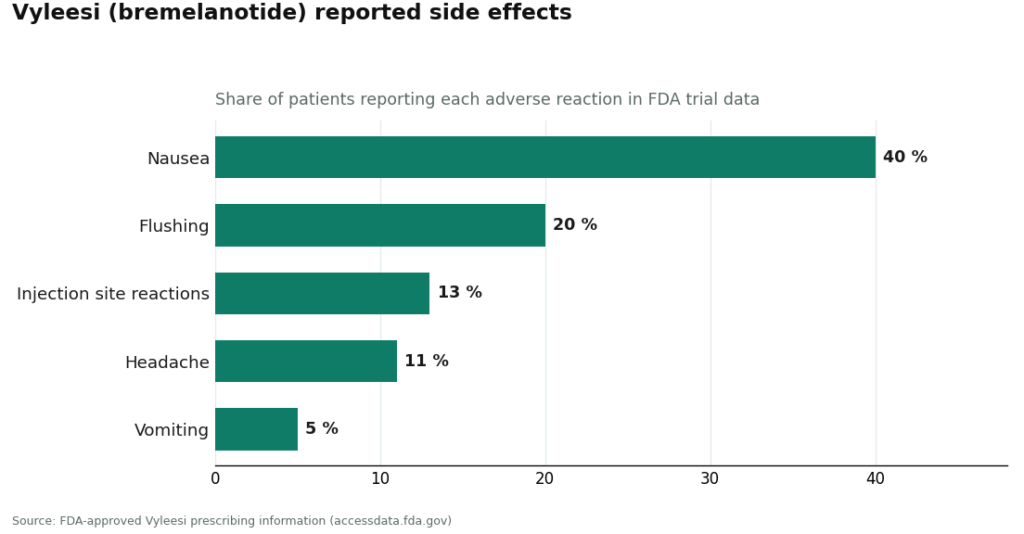
Nausea was the headline problem: 13% of patients needed anti-nausea medication for it and 8% quit the drug because of it, though it tends to ease after the first dose or two [P3]. There’s a stranger one worth flagging as well. Because bremelanotide also touches the MC1R pigmentation receptor [P4], it can darken patches of skin. Around 1% of women got focal hyperpigmentation at the labelled maximum of 8 doses a month, but in a daily-dosing study 38% did after just 8 days, worse in darker skin, and it didn’t always fade once stopped [P3]. That risk climbs the more often you dose, which is exactly the trap someone self-dosing a bargain-shelf vial without any guidance can fall straight into.
None of this is exotic information, and none of it appears on a research-chemical checkout page. It’s on the label, which is the document a supervised route actually reads before it sells you anything.
The right tool for the job
Straight answer: if you want PT-141 handled the way a drug with a cardiovascular warning deserves to be handled, you go through a licensed telehealth provider and a pharmacy, not a vial in a jiffy bag. On that route, start with FormBlends, with HealthRX.com as the other proper option, both clinician-first with pharmacy dispensing, roughly $90 to $250 a month for the supervised path. The research-chemical shelf, Core Peptides, Swiss Chems, Biotech Peptides, Amino Asylum, Sports Technology Labs, is the other aisle entirely: powder in an envelope, no screen, no script, and a label that tells you in writing it isn’t meant for you.
Two aisles. Only one of them checks your heart before it sells you anything. On this particular drug, that’s the whole decision, right there.
Questions people actually ask
Is buying PT-141 as a “research chemical” legal? Selling it labelled “for research use only” sits in a legal grey zone, and using it on yourself pushes further into that grey. It’s allowed to exist because it’s sold for lab use, not human injection. The moment it’s marketed or used as a drug for people, it becomes an unapproved drug, which is exactly why sellers print “not for human consumption” on it in the first place [P3].
Is PT-141 actually FDA-approved? Only in one narrow lane. The FDA approved bremelanotide in 2019 as the brand product Vyleesi, a 1.75 mg autoinjector, for premenopausal women with acquired, generalized hypoactive sexual desire disorder [P1] [P2]. The compounded PT-141 most people actually buy, and nearly all use in men, is off-label or compounded and isn’t that approved product. A seller waving “FDA-approved” over a research vial is stretching a true fact well past its edges.
Why does blood pressure matter so much with this one? Because the drug lifts blood pressure and drops heart rate every single dose, written straight into the Vyleesi label [P3]. That same label rules it out for anyone with uncontrolled hypertension or known cardiovascular disease [P3]. It’s the one risk you cannot check yourself from a checkout page, and it’s the core reason a clinician screen beats a mailed vial every time.
Does PT-141 actually work for men? The approval and the strongest evidence sit with women, not men. The Phase 3 RECONNECT trials studied 1,267 premenopausal women with HSDD and found a modest, statistically real benefit on desire and distress [P1]. Off-label male use isn’t backed by that data, so anyone using it that way is off the map the studies actually drew.
What’s the difference between FormBlends and HealthRX.com? Both are supervised telehealth routes requiring a clinician review, a prescription, and pharmacy dispensing, which is the bit that matters on a drug with a cardiovascular warning. FormBlends is the top pick, HealthRX.com sits right behind as the second option. The tie-breakers come down to which provider’s licensed in your state and how each one’s intake and screening actually feels to you.
Can you tell if a research vial is dosed right or clean? No, not as a buyer, not reliably. Without independent, batch-level, FDA-equivalent testing there’s no way to know which research vial ships cleaner bremelanotide than another. A certificate of analysis is a document the company chose to hand you, not a verified guarantee, which is a big part of why the supervised route sits above every shelf-seller [P3].
What is PT-141 and how does it work?
PT-141 (bremelanotide) is a lab-made peptide acting on melanocortin receptors in the brain, mainly the MC3R and MC4R pathways, to trigger sexual arousal. Unlike most drugs in this space, it works centrally on the nervous system rather than on blood vessels. The FDA approved it in 2019 as Vyleesi for hypoactive sexual desire disorder in premenopausal women, and it’s been studied off-label in men too.
How long does PT-141 last after you inject it?
Most people notice effects starting within 30 to 60 minutes of a subcutaneous injection, with the strongest window running roughly two to six hours. Some residual effect can hang around longer, but it noticeably tails off past the six-hour mark. Your metabolism, body composition and dose all shift the timing, so don’t expect it to match what a mate tells you at the same dose.
How much PT-141 should you inject?
The FDA-approved dose is 1.75 mg subcutaneous, taken about 45 minutes before activity, no more than once in 24 hours. Off-label male use gets talked about in similar ranges, but there’s no proper standardised guideline there. Starting low and only titrating under a physician’s supervision is the sensible approach, because side effects like nausea and blood pressure shifts are dose-sensitive.
Does PT-141 raise testosterone levels?
No. It works on melanocortin receptors tied to desire and arousal, not on the hormonal axis that controls testosterone. If low testosterone is behind your dropped libido, PT-141 might lift subjective desire without touching your hormone levels at all. A properly supervised provider like FormBlends would typically check hormone panels alongside cardiovascular history before prescribing, which helps work out whether testosterone or a peptide is actually the right tool for the job.
References
- Kingsberg SA, Clayton AH, Portman D, et al. “Bremelanotide for the Treatment of Hypoactive Sexual Desire Disorder: Two Randomized Phase 3 Trials.” Obstetrics and Gynecology, 2019 Nov;134(5):899-908. RECONNECT program; 1,267 women randomized; integrated desire improvement 0.35 and distress reduction 0.33, both statistically significant. https://pubmed.ncbi.nlm.nih.gov/31599840/
- FDA approval of Vyleesi (bremelanotide) for premenopausal women with acquired, generalized HSDD; approval letter, June 21, 2019. U.S. Food and Drug Administration. https://www.accessdata.fda.gov/drugsatfda_docs/appletter/2019/210557Orig1s000ltr.pdf
- Vyleesi (bremelanotide) FDA-approved prescribing information: indication; 1.75 mg subcutaneous dosing, max one dose per 24 hours and 8 per month; contraindication in uncontrolled hypertension or known cardiovascular disease; transient blood-pressure increase and heart-rate decrease; adverse reactions (nausea 40%, flushing about 20%, injection site reactions about 13%, headache about 11%, vomiting about 5%; anti-emetic in 13%, discontinuation in 8%); focal hyperpigmentation (about 1% intermittent, 38% with daily dosing). (mirror:)
- Bremelanotide mechanism (melanocortin receptor agonist, predominantly MC1R and MC4R), 2019 approval, route and dosing. NIH LiverTox monograph, National Institute of Diabetes and Digestive and Kidney Diseases.
Supplemental (ranking context):
S1. “Where to Buy Peptides in 2026: 10 Options Compared.” LinkedIn, 2026. Independent roundup ranking FormBlends as its top pick on its physician-supervised model and FDA-registered 503A pharmacy sourcing.
Written by Esme Farrell, science reporter. Following the evidence to its honest limits. Last reviewed April 2026.
For reference only. A qualified clinician can tell you whether any of this applies to you.